()oacres
oacres (gexpr, sexpr <,radii>)
A Cressman objective analysis is performed on the station data to arrive at a gridded result that represents the station data.


oacres (gexpr, sexpr <,radii>)
A Cressman objective analysis is performed on the station data to arrive at a gridded result that represents the station data.
oabin (gexpr, sexpr <,-flag>)
This function bins station observations into grid cells based on their location. If more than one station is located within a grid box, the observations are averaged together to produce the analyzed value.
Sets up the color characteristics of a button widget. The syntax is:
set button <button_ON_colors> <button_OFF_colors> thickness
redraw button num 0|1
Redraws button number num to either the "ON" state (1) or "OFF" state (0).
draw button number xpos ypos width height string
Draws a button centered on xpos,ypos with the
following attributes:
There are many supplemental libraries that are required to enable various features in the grads executable. Building all these libraries from source is not necessarily easy; this page provides some guidance and suggestions that have led to success on COLA's unix systems (64-bit linux running CentOS, and Mac OSX). COLA's objective in building grads is to make our binary releases portable, so we strive to build all the libraries from scratch, disabling features grads doesn't need, and then link statically when building grads. If you are building grads from source but not planning to distribute your build, then you may find that many of these libraries are already installed on your system and you can link with them dynamically. In this case, use the --enable-dyn-supplibs option with the GrADS configure script. Please post questions about building from source to the GrADS Users Forum. If you have the proper privileges, you may install these anywhere on your system instead of $HOME, just be sure to change the commands listed in the table below to accomodate your own installation.
Reading BUFR Files with grads
BUFR (Binary Universal Form for the Representation of meteorological data) is a World Meteorological Organization (WMO) standard for storing observational data (aka sequence or in-situ data). BUFR is self-describing data format and can store a large amount of data and metadata in a small amount of disk space by using look-up tables and bit-by-bit packing.
There is a grads interface for BUFR, which means that BUFR
data can be read directly in their native format and are handled as a grads
station data set with all the associated display an analysis capabilities. grads
requires a specially-formatted descriptor file to read BUFR data; the output
from bufrscan, an external
grads utility, is used to compose the descriptor file.
تعداد صفحات : 20
 set yflip Flips the order of the vertical axis
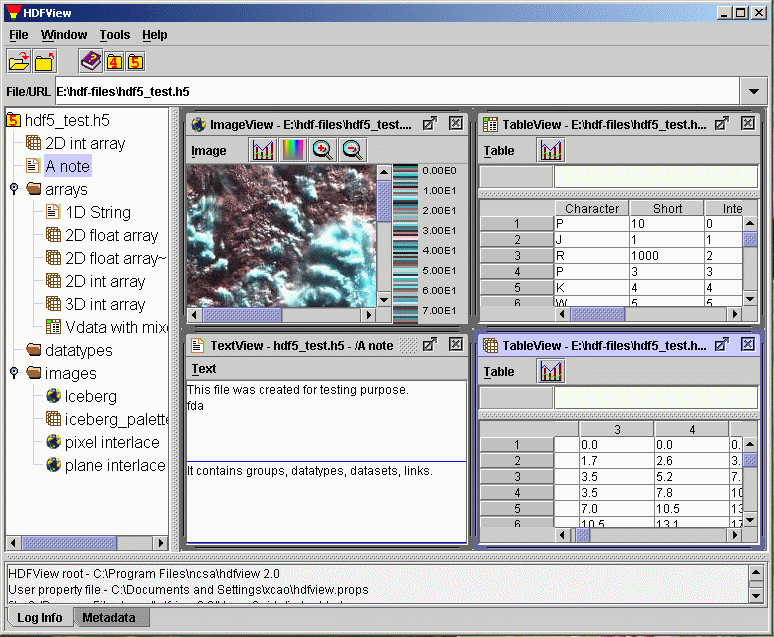 HDF View Version 3.2.0 Free Download 2022
 Download Software For the Linux Grads Version 2.0.1 -2.0.2